
Gartner’s Top 3 Strategic Priorities for Sales Enablement Leaders
Sales enablement is at a crossroads. For years, it’s been about content. Decks. Playbooks. Training sessions.
That’s no longer enough: Enablement must now become a performance engine — one that shapes seller behaviour, scales execution, and proves impact. Especially as AI reshapes how sales teams work.
Sales enablement is at a crossroads. For years, it’s been about content. Decks. Playbooks. Training sessions.
That’s no longer enough.
Here are the three priorities that matter most for founders and executives heading into 2026.
Priority 1: Maximise ROI from AI (or It Becomes Noise)
Most leaders believe AI should unlock productivity. Few can show where it actually does. The problem isn’t tools. It’s direction.
Enablement teams often lack a clear charter. Sellers resist change. Initiatives pile up. AI gets bolted on without changing behaviour.
Takeaway: AI only creates value when it changes what sellers do, not just what they have.
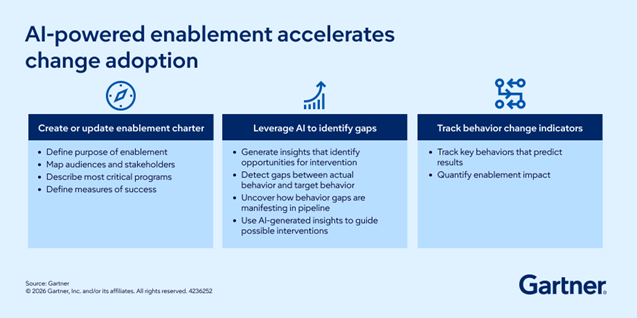
That means:
Defining clear seller behaviours tied to strategy
Using AI to spot gaps in performance, not just report activity
Tracking behaviour change as a leading indicator, not lagging revenue
AI should tell you:
Where deals stall
Which behaviours separate top performers
What intervention actually works — and when
If you can’t prove impact, AI is just another shiny tool.
Founder reflection: If you removed revenue results, could you clearly describe the seller behaviours AI is improving today?
Priority 2: Use Technology and Data to Scale What Works
Buyers are changing faster than enablement programs. Static training can’t keep up. Quarterly updates are already obsolete. Gartner argues enablement must move from programs to systems.
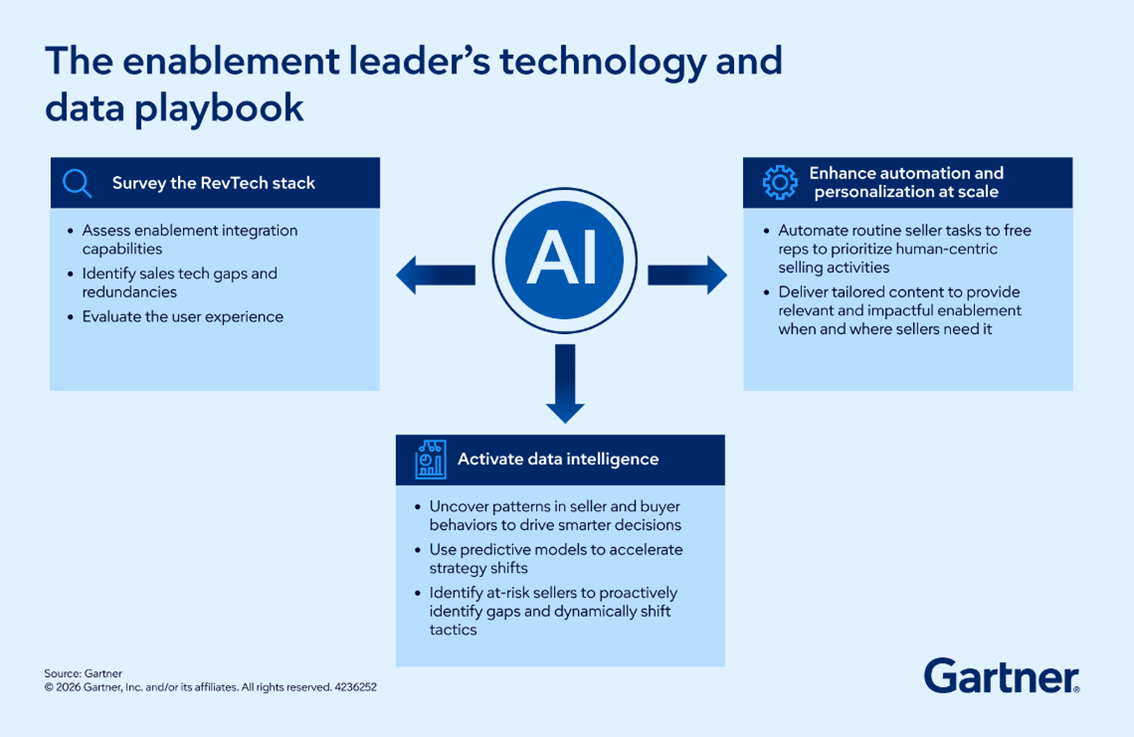
That means:
Auditing the full revenue tech stack
Connecting data across CRM, enablement, coaching, and forecasting
Activating predictive signals, not just dashboards
The goal isn’t more data. It’s earlier insight.
AI should:
Flag risk before deals go dark
Surface the right content inside the seller’s workflow
Automate low-value tasks so sellers stay in the field
This is how enablement scales without adding headcount. Not by doing more work. By orchestrating performance in real time.
Founder reflection: Where does your revenue team still rely on static training instead of live, data-driven signals?
Priority 3: Redesign Talent for an AI-First World
Here’s the uncomfortable truth. Many enablement skills were built for a pre-AI era. Content creation. Manual training design. One-size-fits-all programs.
AI now does much of this faster and better. Gartner’s view is clear: enablement teams must upskill or become irrelevant.
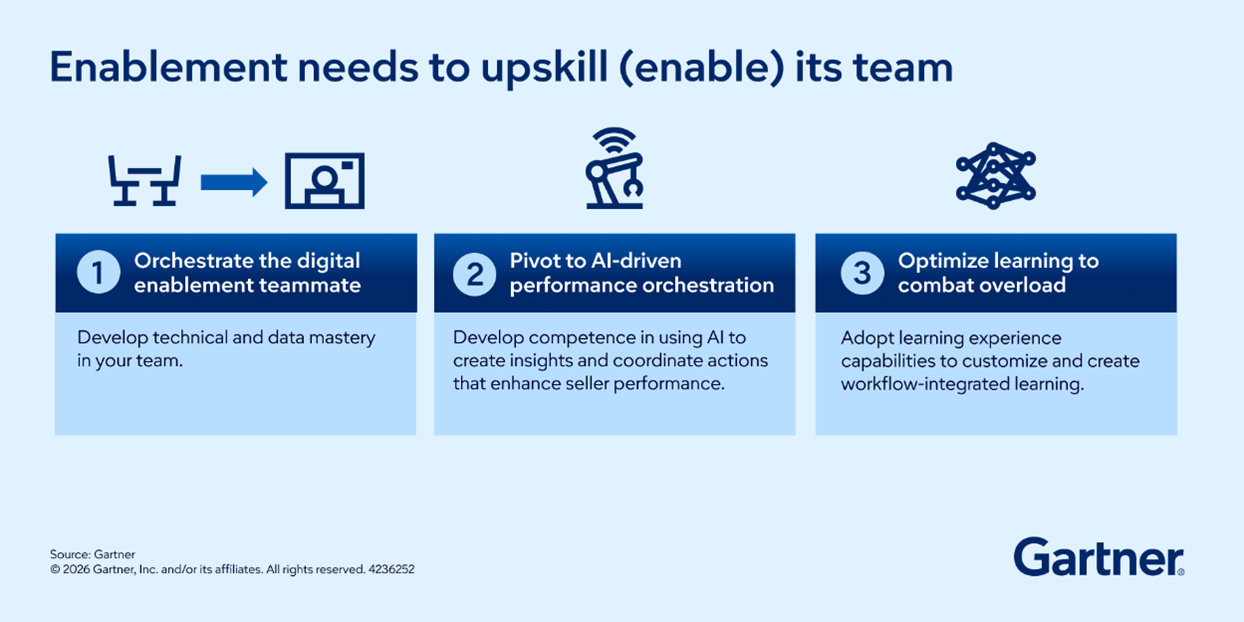
The future skill set looks different:
Data literacy
AI fluency across the sales tech stack
Performance orchestration, not content production
Enablement’s role shifts from creating information to guiding decisions.
AI enables:
Hyper-personalised learning
Scenario-based reinforcement
Real-time feedback inside deals
When done well, AI Enablement of your team reduces noise and focuses sellers on what matters now.
Founder reflection: If AI removed manual training and content creation tomorrow, would your enablement team still know how to drive performance?
Final Thought
Sales enablement is no longer a support function. It’s a strategic lever. Founders who treat it that way will move faster, adapt quicker, and scale smarter. Those who don’t will keep wondering why their tools aren’t paying off.
Source: Sales Enablement Leadership Vision 2026 | Gartner
